




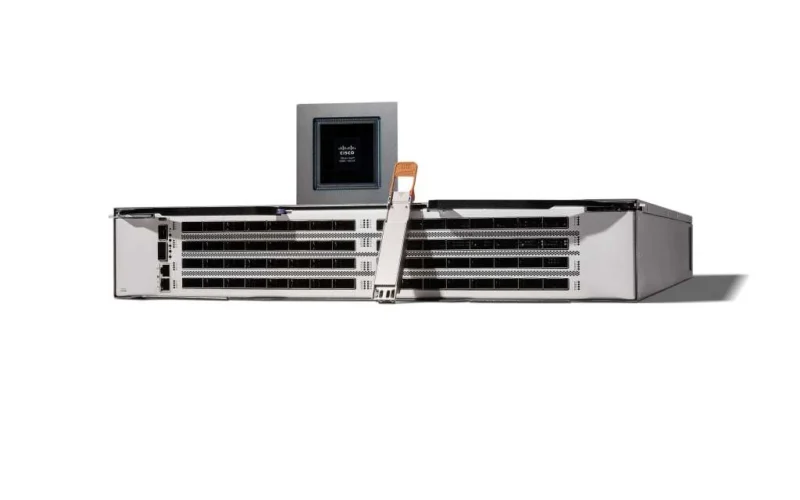
Cisco has enhanced its Silicon One portfolio with the launch of the groundbreaking 102.4 Terabit/sec G300 chip, alongside high-capacity switches designed specifically for a range of customers, including hyperscalers and service providers. This significant upgrade aims to meet the demands of massive AI clusters and sophisticated data handling.
The G300 is built with a variety of advanced features, including Intelligent Collective Networking, which facilitates efficient data management by supporting shared packet buffers, path-based load balancing, and proactive network telemetry. These capabilities are essential for handling the increased data flow often seen in AI workloads such as training and inference.
According to Nick Kucharewski, senior vice president of Cisco’s silicon development organization, the G300 will revolutionize Ethernet switching for AI networks. It integrates 1.6T Ethernet ports with low power consumption and enhanced performance, allowing for a more efficient architecture that minimizes compute latency and simplifies connectivity to computational resources.
In testing, the chip’s increased packet buffering led to a 33% rise in network throughput, which is instrumental for those managing significant GPU workflows without the need to expand network infrastructures or add additional switches, thereby reducing operational costs.
Additionally, Cisco introduced two new switch models powered by the G300 chip: the 3RU 8133 air-cooled model and the 2RU 8132, which is the company’s first water-cooled switch. Both are crafted to support the demanding bandwidth and performance needs associated with AI operations.
Cisco’s expansion of its Silicon One entails the addition of the G200 and G100 chips, catering to various networking needs, from spine to leaf operations. The recent launch builds on Cisco’s previous release in October, where they introduced the P200 Silicon One chip focused on distributed AI workloads.
Enhancements to the Nexus One management platform will also aid users in gaining better control over their AI deployments. This updated version incorporates Cisco N9000 systems and provides features that allow visibility into network operations and GPU behaviors via a unified management interface.
With these advancements, Cisco is positioning itself at the forefront of AI networking, offering solutions that satisfy the evolving demands for speed, efficiency, and operational oversight in data centers.
For further details on Cisco’s new offerings, you can find more information about the Silicon One and their innovative networking solutions.


