




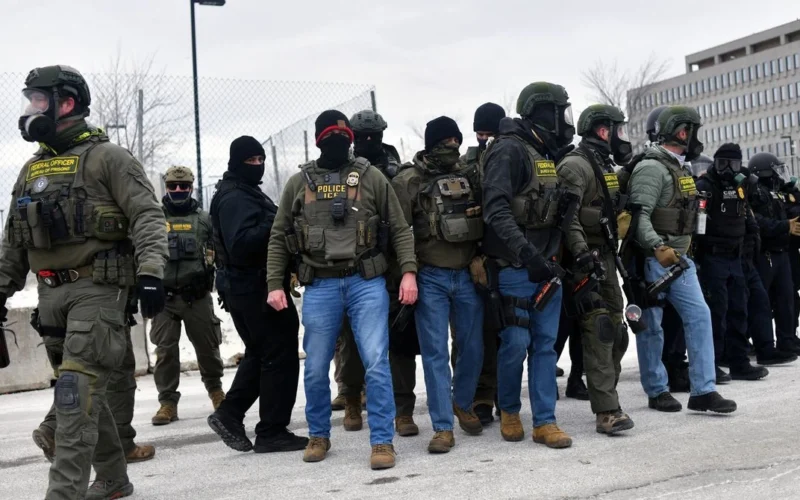
As a veteran of the war on terror, I’ve closely observed the alarming evolution of Immigration and Customs Enforcement (ICE) in recent times, particularly under the new administration’s directives. ICE has escalated its operational presence across the country, adopting a military-like demeanor that is not only unnecessary but also potentially hazardous. This peculiar militarization of a civilian law enforcement agency merits scrutiny, especially when its practices could be analyzed through a military lens to uncover troubling implications.
A pivotal moment occurred recently when White House border czar Tom Homan referred to Minneapolis as a "theater" for ICE agents. Despite being a civilian agency, ICE seems intent on modeling itself after military forces, which raises the question of whether their tactics are appropriate for enforcing immigration laws.
Considering equipment and tactics, soldiers tailor their gear to the specific mission at hand. For instance, while conducting counterinsurgency operations, military units often adjust their appearance to build trust within local communities. In stark contrast, ICE agents frequently show up looking like they are preparing for combat, adorned with tactical gear and heavy armaments suited for warfare rather than civil enforcement.
The operational methods employed by ICE agents are similarly misguided. They often converge in clusters, a tactic that could be disastrous in a real combat scenario. Their approach overlooks the reality that those they are confronting are not a military enemy; they are individuals who may or may not have violated civil law. This misinterpretation leads to excessive displays of force, often instilling unnecessary fear in the communities they serve.
As a military officer, I can attest to the importance of tactical precision in operations. In contrast, the chaos surrounding ICE raids, characterized by officers bumbling and engaging bystanders, reflects a disorganized approach to law enforcement. Military operations involve clear roles and responsibilities, aiming to reduce confusion and maintain unit integrity, which is glaringly absent in ICE enforcement actions.
Moreover, the tactics being employed often escalate tension rather than defuse it. Counterinsurgency practices have demonstrated that de-escalation can lead to fewer civilian casualties—a lesson ICE appears to overlook entirely. Their current methods, which prioritize intimidation and aggression, echo the more regrettable aspects of military operations during the war on terror, fostering resentment rather than compliance from affected communities.
When considering the broader implications of these tactics, it becomes apparent that ICE’s operational strategy may align with a theory of control employed by authoritarian regimes. The use of terror tactics can creates a climate of fear, legitimizing severe measures that might otherwise be condemned. This strategy seems aimed not at increasing deportations—perhaps a misguided political goal—but rather at establishing an environment in which such actions can be justified.
Despite ICE’s attempts to project a military presence, it remains fundamentally a civilian law enforcement agency, tasked with upholding the Constitution. The militarization of their approach raises serious concerns about their alignment with the constitutional principles they are sworn to defend.
Observing these developments feels like a troubling return to the worst practices of the war on terror, where the focus shifted from constructive law enforcement to coercive displays of power. Many in the military share a commitment to upholding the law with integrity and respect for human dignity—values that are increasingly at risk in ICE’s current operational paradigm. The misguided tactics employed by ICE not only risk the agency’s efficacy but also threaten to undermine public trust and respect for the rule of law itself.