





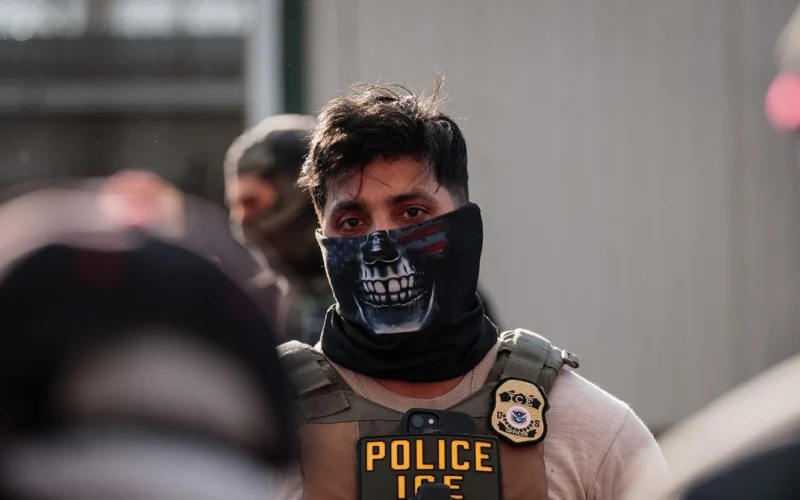
The Trump administration has taken legal action against five states and the city of Philadelphia, objecting to laws aimed at increasing accountability for law enforcement, including Immigration and Customs Enforcement (ICE) officers. The core contention revolves around regulations that mandate ICE officers to remove their masks during immigration raids and wear identifiable badges.
Federal attorneys argue that revealing their identities would expose ICE agents to risks, highlighting concerns that their images could be uploaded to facial recognition applications, notably citing the art project ICESpy. This project, however, has been contested by its creator, who states that the program’s software cannot recognize most current ICE personnel due to its reliance on outdated LinkedIn data.
The information within ICESpy comes from records nearly a decade old, documenting only a fraction of the current agents. Most significantly, the number of ICE agents has recently increased dramatically, further disconnecting the project’s dataset from current realities.
According to Kyle McDonald, the artist behind ICESpy, the DOJ’s claims lack substantiation, and the notion that one could actively identify a present-day ICE officer via this site is unfounded. He asserts that the evidence presented in the legal filings does not back the assertions of danger that the government claims exist.
Beyond ICESpy, the federal government also critiques another site, ICE List, which tracks ICE officers for accountability. ICE List features profiles of agents, including job titles and incident reports, but as explained by its maintainer, Dominick Skinner, the site predominantly relies on manual research rather than automated face recognition due to its limited success rate.
In the context of recent incidents involving ICE agents, including two fatal shootings, state lawmakers defending their laws argue that demands for agent accountability are essential for democracy and justice. They posit that instead of challenging these laws, the DOJ should focus on investigating misconduct by ICE agents and fostering constructive changes within the agency.
The debates surrounding these laws and the state’s rights to regulate law enforcement practices highlight a broader struggle over transparency and accountability in immigration enforcement, emphasizing the balance between operational security and public oversight.


