




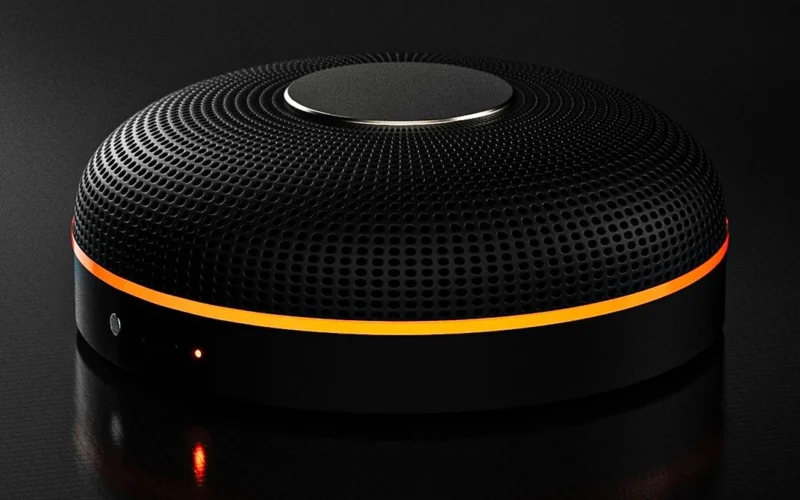
A startup named Deveillance, founded by a recent Harvard graduate, has introduced a device called Spectre I, which aims to give individuals the ability to block audio recording by nearby devices. This innovative gadget is designed as a portable tabletop orb that combines ultrasonic frequency emitters and artificial intelligence to jam microphones and log their presence, although it is still under development and is slated for release at approximately $1,199 in late 2026.
The launch of the Spectre I has sparked considerable conversation online, with some enthusiasts viewing it as a piece of cyberpunk-style tech meant to combat the rise of always-listening AI devices, while others express skepticism about its feasibility. Aida Baradari, the founder of Deveillance, stated, “I didn’t expect it to go this viral,” appreciating the interest in privacy-related solutions.
Baradari developed the Spectre I in response to growing concerns regarding devices that continuously listen to conversations, such as products from Amazon-owned Bee AI. She emphasizes the importance of personal choice in what individuals share during conversations. “If we can’t converse anymore without feeling scared of saying something that’s potentially taken out of context,” she remarked, “then how are we going to build human connection in this new age?”
The urgency surrounding privacy issues is underscored by the increasing capabilities of government surveillance in the U.S. and the aggressive data collection practices of major tech companies. This has led to heightened awareness and criticism of ubiquitous recording devices and their implications on personal privacy, particularly following a controversial Super Bowl advertisement by security camera company Ring.
Skepticism regarding the effectiveness of the Spectre I persists among experts. Critics highlight the challenges posed by physics in creating a compact device that effectively jams microphones. The technology relies on AI to produce cancellation signals to interfere with automatic speech recognition systems. However, the initial iteration of the device has resulted in an audible hum, raising questions about its efficacy in real-world environments.
The concept of jamming microphones isn’t new; ultrasonic microphone jammers have existed since the Cold War. Baradari noted the aim is to create a lightweight device despite the inherent challenges, arguing that the integration of AI allows for targeted frequency emissions designed to muddle human voices while preventing post-processing reconstruction by speech recognition technology. Nevertheless, linguistic experts warn that the variability in human voices may complicate the approach.
Additionally, Deveillance claims Spectre I can detect nearby microphones by picking up radio frequency emissions, but experts argue that such detection is only effective at close range. There’s also concern about potential health implications of emitting ultrasonic frequencies, particularly for pets and sensitive individuals.
As the discourse around the Spectre I continues, Baradari has taken the criticisms constructively, acknowledging the need for further development and refinement of the device. It seems that while some may mock the design’s ambition, the enthusiastic response highlights a foundational desire among consumers for enhanced privacy protections.
In conclusion, the Spectre I taps into a broader societal demand for privacy in an increasingly surveilled world. This product embodies the complex intersection of technology, privacy rights, and individual autonomy, making it subject to both excitement and skepticism as it approaches its launch date.