





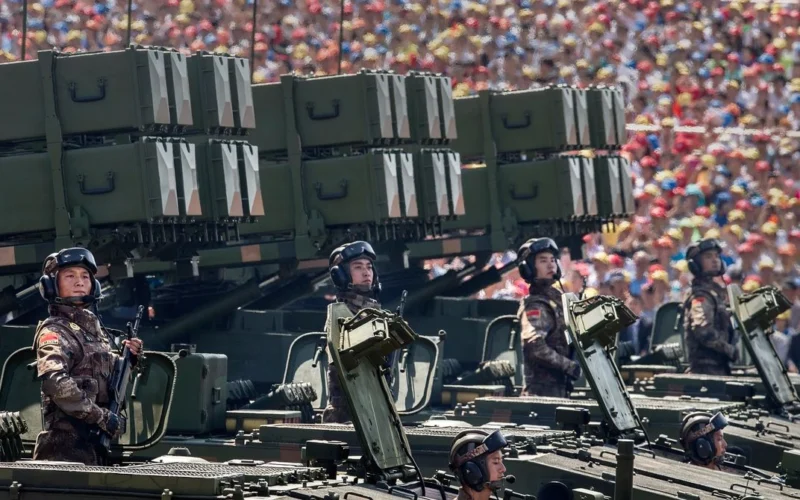
On September 3, China will host a highly anticipated military parade in Tiananmen Square to commemorate the 80th anniversary of its victory over Japan in World War II. This event is anticipated not only as a moment of historical reflection but also as a strategic demonstration intended to convey a message to global powers, particularly the West. President Xi Jinping will oversee the parade, attended by notable foreign dignitaries, including Vladimir Putin. The presence of Putin has already raised tensions, leading some European ambassadors to contemplate boycotting the event out of concern that it would lend undue legitimacy to Russia amid the ongoing Ukraine conflict.
The parade will unfold over approximately 70 minutes along Chang’an Avenue in Beijing, featuring over 10,000 military personnel, more than 100 aircraft, and hundreds of military vehicles. While the official theme emphasizes peace and international justice, the real focus will be on showcasing the People’s Liberation Army’s capabilities in high-tech warfare across various strategic domains: cyberspace, outer space, electronic warfare, and hypersonic technology.
Notably, among the advanced weaponry set to be displayed are the new YJ series anti-ship missiles (YJ-15, YJ-17, YJ-19, and YJ-20), specifically designed to target large US naval vessels, including aircraft carriers. These weapons are part of China’s A2/AD (Anti-Access/Area Denial) strategy aimed at securing its interests in key areas like the South China Sea and the Taiwan Strait. Over the past decades, China has significantly advanced its anti-ship missile technology, moving from Soviet designs to more sophisticated indigenous variants that integrate stealth, speed, and artificial intelligence.
Also expected at the parade are advanced mobile intercontinental ballistic missiles (ICBMs) like the DF-31AG and DF-41, which are intended to maintain China’s nuclear deterrence capabilities. The DF-41 is particularly notable for its long range and multiple warhead capacity. Furthermore, the JL-3 submarine-launched ballistic missile will also feature, highlighting China’s focus on a comprehensive nuclear deterrent strategy.
In terms of aerial capabilities, the parade is set to present the FH-97, China’s first unmanned combat aircraft, which is designed to work alongside manned fighters. This drone, if confirmed, would give China an edge in drone warfare, marking a significant step in its technological advancement in military aviation.
Additionally, China is investing heavily in electronic warfare and directed-energy weapons, which have the potential to disrupt enemy operations silently. These systems can incapacitate radar and communications technology, bolstering China’s capacity to conduct conflicts in a digitally dominated arena.
The unveiling of these advanced systems at the September 3 parade is a salient signal from Beijing, asserting that it has not only caught up with Western military capabilities but aims to exceed them in specific domains. The event will serve as a potent reminder of China’s aspirations to reshape the regional and global security landscape.


