




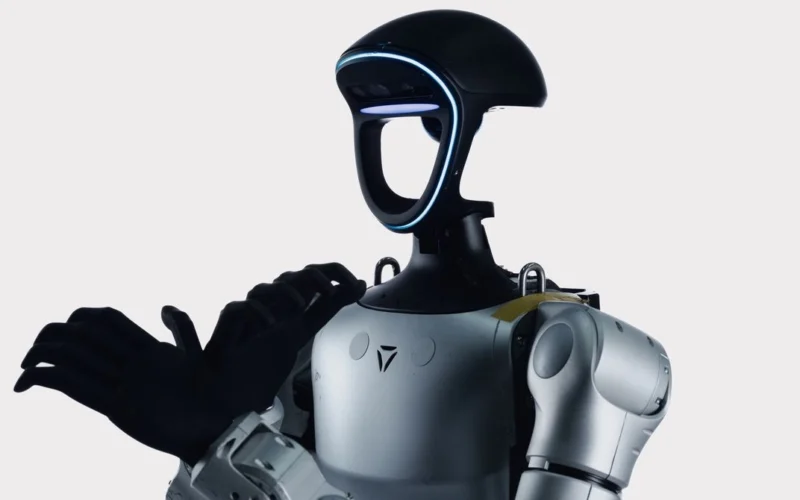
The 4-foot-tall humanoid robot at the World Artificial Intelligence Conference in Shanghai displays a chaotic energy, swaying on its legs and gesturing wildly before stopping abruptly. Surrounded by a myriad of other robots—some dancing, some delivering packages, and a few in need of battery recharges—this scene serves to illustrate the rapid evolution of humanoid robotics in China.
Exploring the AI landscape here, there’s a noticeable contrast to the West, with sleek electric cars by BYD and Xiaomi populating the streets. The conference hall buzzes with activity, as onlookers marvel at two humanoids boxing, demonstrating the entertainment potential of robotics.
However, the impressive display is somewhat misleading; many humanoids rely on remote control for their movements, limiting their autonomy. While they can perform basic tasks, most still lack dexterity, often ending with flat stumps instead of fingers, restricting their ability to grip objects.
Experts predict a seismic shift in work dynamics due to the introduction of humanoid robots into the workforce. Companies like Amazon are actively testing humanoids, looking to integrate them for significant labor savings. Analyses suggest that by 2035, robot makers may sell up to 10 million humanoids annually, with China positioned to dominate the market.
Among the leading manufacturers is Unitree, based in Hangzhou, which has overtaken competitors like Elon Musk’s Optimus in terms of agility and price. Unitree is a frontrunner with plans for a $7 billion IPO, riding the coattails of over 200 other Chinese startups pushing the boundaries of robotics.
During a visit to Unitree’s headquarters, it becomes clear that the company thrives on China’s efficient manufacturing ecosystem. Local components allow rapid iteration and cost reduction—key advantages that underpin Unitree’s success. CEO Wang Xingxing, who began his robotics journey as a university student, has ambitious plans for humanoids that can perform a range of tasks from factory work to serving tea. His ventures have caught the attention of top governmental figures and experts alike.
At the Beijing Academy of Artificial Intelligence, another critical player in the robotics landscape, researchers are developing open-source models combining machine learning with robotic functions. They explore the capabilities of AI to learn from observation, envisioning a future where robots can autonomously navigate unfamiliar environments and follow commands more intuitively.
Yet, despite the optimism surrounding robotics, the development and deployment of humanoids face significant challenges, including the need for advanced hardware that can better replicate human tactile senses. With rapid advancements from Chinese firms, there’s a sense of urgency for American companies to innovate or risk falling behind.
The competition is intensifying as industry leaders speculate on a landscape where the US contributes cutting-edge AI while China handles the hardware. Tensions are high, as American firms may need government intervention to bolster domestic capabilities, mirroring the thick support Chinese tech giants receive from their government.
As the trip concludes, the human element prevails, leaving a lasting impression: while robots are emerging on the scene, the intricate human labor that supports daily life remains irreplaceable—at least for now.