




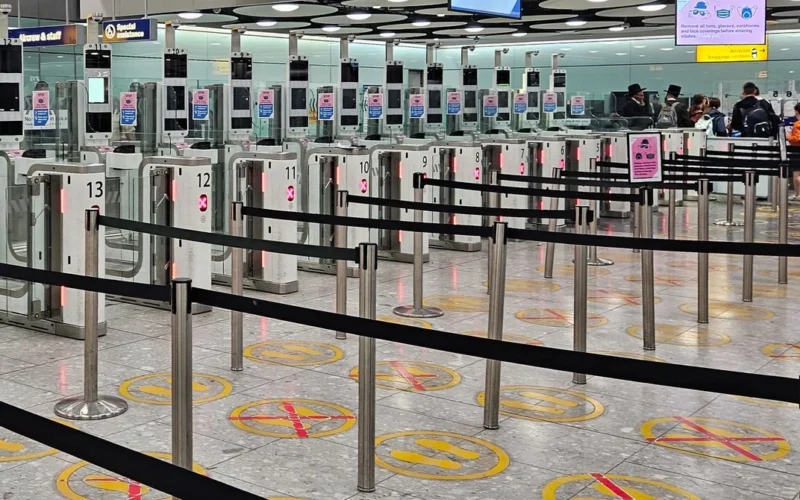
The UK government is set to implement facial age estimation technology to verify the ages of asylum seekers, starting next year. This decision marks an unprecedented use of AI for age checks in the immigration process. As many asylum seekers arrive without documentation, inaccurately classifying children as adults could result in the loss of crucial legal protections and placement in adult detention facilities.
An investigation by WIRED and Lighthouse Reports uncovered an internal Home Office report revealing that the facial age estimation (FAE) technology often misidentifies children as adults, particularly impacting Sub-Saharan African migrants, who represent the largest group seeking asylum in the UK. The report showed that errors in age prediction could be severe—such as misclassifying a 13.5-year-old girl as 18.
Concerns have arisen as the Home Office has previously disbanded a scientific committee meant to evaluate age estimation methods while moving toward adopting FAE technology. Experts highlight the inaccuracy of these systems, especially in assessing individuals from different demographic backgrounds, as they’ve found bias based on race and photo quality. The leaked report indicated that the “best” algorithm tested at the time was significantly less accurate for Sub-Saharan Africans compared to other demographics.
Amidst the ongoing debate over privacy and surveillance technology, critics like rights group Foxglove fear that deploying this flawed technology could unfairly target vulnerable groups without adequate recourse or understanding of its implications. Following the plan’s announcement, over sixty organizations urged the government to reconsider the use of FAE systems, citing ethical concerns regarding their empirical shortcomings.
Despite the issues raised by the investigation, the Home Office defended its initiative, stating that FAE technology would supplement, not replace, human judgment in age assessments. However, critics are wary of how this technology could become normalized at borders and potentially lead to dehumanization of the asylum process.
In essence, while AI-driven systems like facial age estimation may offer new approaches to age verification in the immigration landscape, the uncertain impact on vulnerable individuals and the documented inaccuracies raise serious ethical and practical questions that the UK government will need to address before widespread implementation occurs.